


hCD3EDG/hDLL3
Nomenclature
C57BL/6JSmo-Cd3etm1(hCD3E)Cd3dtm1(hCD3D)Cd3gtm1(hCD3G)Dll3tm1(hDLL3)Smoc
Cat. NO.
NM-XA-240036
Strain State
Repository Live
Gene Summary
Gene Symbol
Dll3
Model Description
Validation Data

Fig.1 Detection of humanized DLL3 expression in male hCD3EDG/hDLL3 mice by RT-PCR.
Homozygous: one band at 282 bp with primers F2/R2(hDLL3).
Abbr. M, DNA marker; HO, homozygous; WT, wild type.

Fig.2 Detection of humanized DLL3 expression in female hCD3EDG/hDLL3 mice by RT-PCR.
Homozygous: one band at 282 bp with primers F2/R2(hDLL3).
Abbr. M, DNA marker; HO, homozygous; WT, wild type.

Fig.3 Detection of mouse Dll3 expression in male hCD3EDG/hDLL3 mice by RT-PCR.
Wild type: one band at 172 bp with primers F1/R1(mDll3).
Abbr. M, DNA marker; HO, homozygous; WT, wild type.

Fig.4 Detection of mouse Dll3 expression in female hCD3EDG/hDLL3 mice by RT-PCR.
Wild type: one band at 172 bp with primers F1/R1(mDll3).
Abbr. M, DNA marker; HO, homozygous; WT, wild type.

Fig.5 Detection of mouse Gapdh expression in male hCD3EDG/hDLL3 mice by RT-PCR.
Wild type and homozygous: one band at 123 bp with primers F/R(mGapdh).
Abbr. M, DNA marker; HO, homozygous; WT, wild type.

Fig.6 Detection of mouse Gapdh expression in female hCD3EDG/hDLL3 mice by RT-PCR.
Wild type and homozygous: one band at 123 bp with primers F/R(mGapdh).
Abbr. M, DNA marker; HO, homozygous; WT, wild type.

Fig.7 Detection of human DLL3 expression in 5 embryos (E10.5~E14.5), whose parents are both HO hCD3EDG/hDLL3 mice, by WB.
Abbr. HO, homozygous.

Fig.8 Detection of human DLL3 expression in 7-14-week-old hCD3EDG/hDLL3 knockin mice by WB.

Fig.9 Detection of (A) body weight, (B) the weights of different tissues and (C) organ index in HO hCD3EDG/hDLL3 mice.

Fig.10 Detection of mIgG(A) and mIgM(B) expression in serum by ELISA.
Abbr. HO, homozygous; WT, wild type.

Fig.11 Detection of immune phenotype in (A) peripheral blood and (B) spleen by FACS.
Abbr. HO, homozygous; WT, wild type.
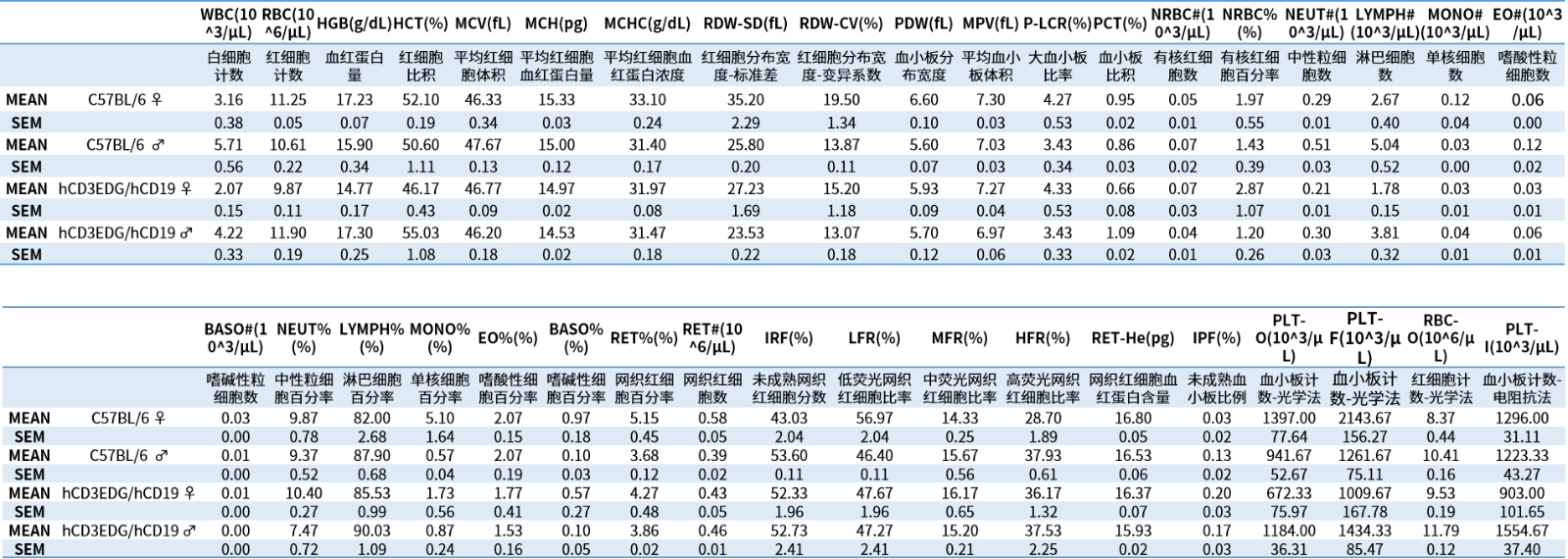
Table 1. Blood routine examination in hCD3EDG/hDLL3 dKI mice (n=3 /group).
You may also like
Shanghai Model Organisms Center Inc has licensed CRISPR-Cas9 technology from Broad Institute
On Dec 16, 2018, Broad Institute and Shanghai Model Organisms Center Inc (SMOC) has entered into a non-exclusive license agreement under which Broad has granted SMOC worldwide rights to commercialize a service platform for genetically modified mouse models under Broad's intellectual property.
Learn moreCustomizing Mouse Models: Delivering in 100 Days to Speed Up Your Research!
At GenoBioTX, we understand that the lengthy wait times for gene-modified mouse models can hinder your research progress. Traditional methods often require 6-9 months, leading to delays and increased costs. That’s why we’re thrilled to introduce our innovative service designed to streamline this process and deliver results faster.
Learn moreMilestones
Our vision is to provide researchers all over the world with comprehensive, convenient and professional animal model services to facilitate a simplified and highly-efficient approach towards uncovering the mysteries of life.
Learn more
