


Pah-R408W
Nomenclature
C57BL/6JSmo-Pahem(R408W)Smoc
Cat. NO.
NM-KI-225103
Strain State
Sperm cryopreservation
Gene Summary
Gene Symbol
Pah
Model Description
Validation Data

Fig.1 Detection of Pah expression in the liver by RT-PCR.
Wild type and Homozygous: one band at 328 bp with primers F1/R1(mPah) and one band at 123 bp with primers F/R(mGapdh).
Abbr. M, DNA marker; HO, homozygous; WT, wild type.

Fig.2 mRNA sequencing of Pah-R408W mice.
Sequencing data of RT-PCR products confirmed the presence of mutations in the Pah-R408W mice.
Abbr. HO, homozygous; WT, wild type.
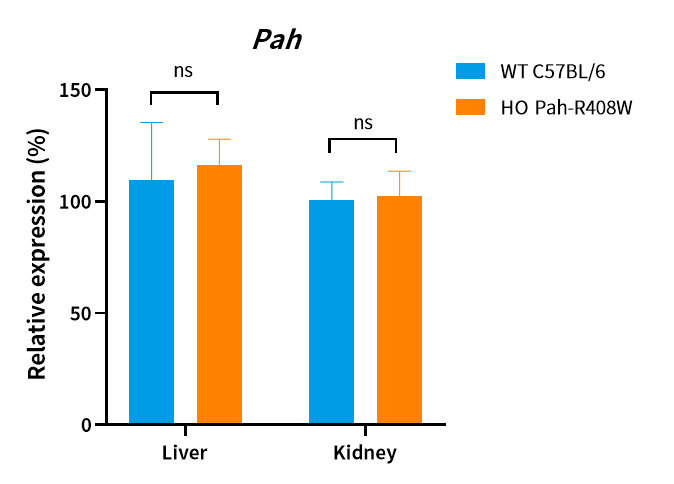
Fig.3 Detection of Pah expression in the liver and kidney by qPCR. (male, n=4 in both groups of the liver detection and n=3 in both groups of the kidney detection, Mean ± SEM. t-test, ns: no significance).

Fig.4 Detection of mouse PAH expression in Pah-R408W mice by WB.
Abbr. M, marker; WT, wild type; HO, Homozygous; PC, positive control, HepG2 cells.

Fig.5 Basic phenotype detection of HO Pah-R408W mice.
(A) Representative photograph showing that Pah-R408W mice exhibit a light-colored hair phenotype compared with WT mice. (B) Body weight analysis indicating that Pah-R408W grow more slowly than WT mice. (C) Brain weight analysis demonstrating that the brain weight of Pah-R408W mice is significantly reduced compared with that of WT mice, suggesting impaired locomotor activity in Pah-R408W mice. (male, C57BL/6: 9wks, Pah-R408W: 9.5wks, n=3 in both groups, Mean ± SEM. t-test, **P < 0.01).

Fig.6 Detection of the locomotor ability by rotarod test.
The rotarod test was performed to evaluate the locomotor function in mice. The result indicated that the Pah-R408W group exhibited shorter latency to fall from the rotating rod compared to WT mice, demonstrating impaired locomotor performance in the Pah-R408W group. (male, C57BL/6: 9.5wks, Pah-R408W: 10wks, n=8 in both groups, Mean ± SEM. Mann-Whitney test, *P < 0.05).
Abbr. WT, wild type; HO, Homozygous.

Fig.7 Detection of the locomotor ability by pole test.
The pole test was also conducted to evaluate the locomotor function in mice. Results revealed that the Pah-R408W group exhibited significant longer time to turn (A) on the pole and to descend (B) compared to WT mice. These findings indicated impaired locomotor performance in the Pah-R408W group. (male, C57BL/6: 9.5wks, Pah-R408W: 10wks, n=8 in both groups, Mean ± SEM. Mann-Whitney test for A, t-test for B, ***P < 0.001).
Abbr. WT, wild type; HO, Homozygous.

Fig.8 Detection of the cognitive behavior by novel object recognition test. The result showed that there is no significant difference between the two groups in cognitive behavior. (n=8 in both groups, Mean ± SEM. t-test).
Abbr. WT, wild type; HO, Homozygous.

Fig.9 Detection of the cognitive behavior by Y-maze test. The result showed that there is no significant difference between the two groups in learning and memory behavior. (n=8 in both groups, Mean ± SEM. t-test).
Abbr. WT, wild type; HO, Homozygous.

Fig.10 Detection of amino acid metabolites in serum of Pah-R408W mice by LC-MS. Results showed that (A) L-Phenylalanine and (C) 4-Acetamidobutyric acid significantly increased in HO Pah-R408W mice, while (B) the ratio of L-Tyrosine/L-Phenylalanine, (D) 5-Hydroxy-Tryptamine and (E) α-Aminoadipic acid reduced in HO Pah-R408W mice, compared with WT mice. (n=3 in both groups, Mean ± SEM. t-test, *P < 0.05, **P < 0.01, ****P < 0.0001).
Abbr. WT, wild type; HO, Homozygous.
Table 1. Detection of metabolites concentrations in the serum of the homozygous Pah-R408W mice.

You may also like
Shanghai Model Organisms Center Inc has licensed CRISPR-Cas9 technology from Broad Institute
On Dec 16, 2018, Broad Institute and Shanghai Model Organisms Center Inc (SMOC) has entered into a non-exclusive license agreement under which Broad has granted SMOC worldwide rights to commercialize a service platform for genetically modified mouse models under Broad's intellectual property.
Learn moreCustomizing Mouse Models: Delivering in 100 Days to Speed Up Your Research!
At GenoBioTX, we understand that the lengthy wait times for gene-modified mouse models can hinder your research progress. Traditional methods often require 6-9 months, leading to delays and increased costs. That’s why we’re thrilled to introduce our innovative service designed to streamline this process and deliver results faster.
Learn moreMilestones
Our vision is to provide researchers all over the world with comprehensive, convenient and professional animal model services to facilitate a simplified and highly-efficient approach towards uncovering the mysteries of life.
Learn more
